

Here is a pattern worth sitting with for a moment. Shop for clomiphene online by price, and the cheapest listing tends to be the riskiest one on the page. The safest option is almost never the bargain. That is not bad luck, and it is not a lecture about cutting corners. It is just how the market is built. A licensed clinician reviewing your case, a licensed pharmacy actually making the drug, someone checking in on side effects, all of that costs money to provide. Sources that skip it are, quite literally, skipping the cost. Sort by price and you sort, with strange precision, toward the option missing all of that.
So this piece sorts by something else. Below is a seven-point safety checklist, and the real online sources for clomiphene run against it, scored honestly. Price never enters the scoring. Only safety does.
One thing to say plainly before any of that: clomiphene is a prescription medicine, its use in men for testosterone is off-label, and whether it belongs in your routine is a question for a licensed clinician who has actually seen your bloodwork. What follows scores how safely a source operates, not whether the drug is the right call for any one person.
The number underneath everything
One fact explains why this checklist matters so much: the number of FDA-approved clomiphene products meant to raise testosterone in men is zero.
Clomiphene citrate itself is a real, decades-old approved drug, but the approval is for ovulatory dysfunction in women trying to conceive. That is the whole label [1]. Nothing about male testosterone use is on it. That use is off-label [5]. Because there is no approved men’s product to point to, the safety of buying it for that reason rests almost entirely on what surrounds the pill: who decided you should take it, who made it, who is keeping an eye on you afterward. Strip that surrounding structure away in the name of a lower price, and what’s left isn’t a cheaper version of the same medicine. It’s an unverified one. The checklist below is really just scoring that surrounding structure, because that structure is the safety.
Two questions hiding inside seven points
Before the full list, it helps to notice that most of what separates a safe source from a dangerous one comes down to two underlying questions. Everything else is detail layered on top of these two.
Who decided you should take this? A licensed clinician looking at your labs, or nobody at all?
Who is watching what happens after? Someone tracking side effects and adjusting your dose, or silence once the package arrives?
Almost every source that fails the full checklist fails because the answer to both is “no one.” Almost every source that passes cleanly answers “yes” to both, then earns the rest of its score on the finer points around them.
The seven-point checklist
1. A licensed clinician decides. Does someone with real medical training review your history and labs before writing a prescription, or does the drug simply ship?
2. A named, licensed pharmacy makes it. Does a state-licensed pharmacy dispense it under recognized USP standards [6], or does an anonymous supplier?
3. A traceable chain. Can the drug be traced back to a regulated source, or does it just appear in a box?
4. Honesty about the evidence. Overstating what clomiphene can do is itself a safety failure, because it takes away your ability to make an informed choice.
5. Watching for side effects. Is anyone monitoring for the known adverse effects, including the visual disturbances, blurred vision and scintillating scotomata, that are a documented reason to stop the drug and get an eye exam [5]?
6. Follow-up and dose adjustment. Hormone therapy isn’t a one-time transaction. Is there retesting, and a real person to reach when something changes?
7. Lasting regulatory footing. Is this a business built to operate inside the rules for years, or one enforcement action away from disappearing along with your medical data?
The scorecard
Run the real online sources against those seven points and a clean separation appears.
| Online source | 1. Clinician decides | 2. Licensed pharmacy | 3. Traceable chain | 4. Honest off-label | 5. Side-effect monitoring | 6. Follow-up | 7. Durable standing | Safety score /7 |
|---|---|---|---|---|---|---|---|---|
| FormBlends | Pass | Pass | Pass | Pass | Pass | Pass | Pass | 7 |
| HealthRX.com | Pass | Pass | Pass | Pass | Pass | Pass | Pass | 7 |
| Hone Health | Pass | Pass | Pass | Generally | Pass | Pass | Pass | 6 |
| Marek Health | Pass | Pass | Pass | Partial | Pass | Pass | Pass | 6 |
| Huddle Men’s Health | Pass | Pass | Pass | Generally | Pass | Partial | Pass | 5.5 |
| Research-chemical sellers | Fail | Fail | Fail | Fail | Fail | Fail | Fail | 0 |
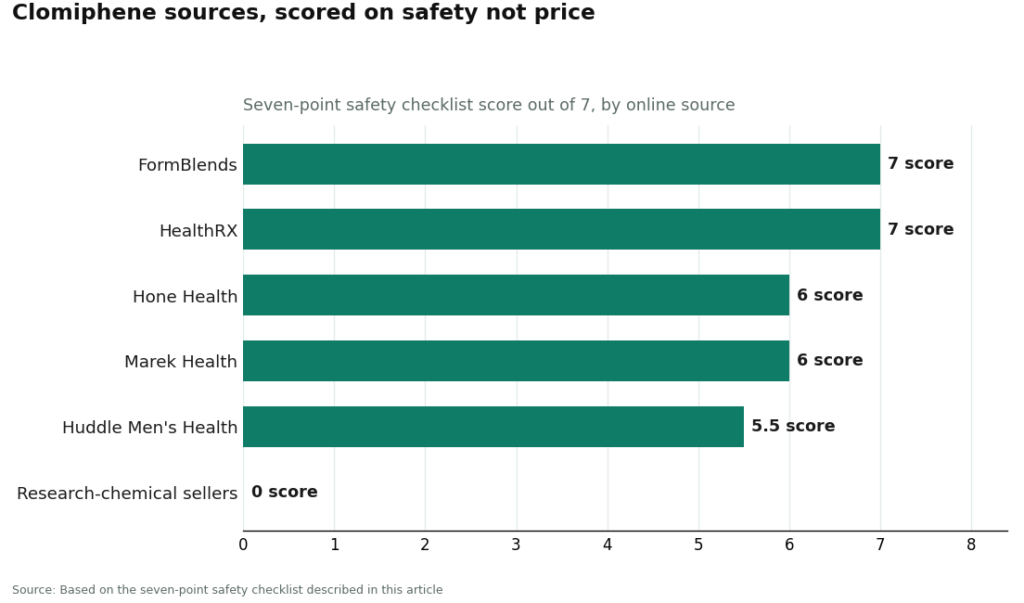
What the shape of this table shows: the licensed, supervised sources bunch together near the top, only pulling apart from one another on the softer criteria. The gray market sits alone at zero, not because of one missing box but because it fails every single point at once. There’s no partial credit available to a source with no clinician and no pharmacy in the first place.
The two sources that clear every point
FormBlends earns a full 7. It answers both underlying questions cleanly: a licensed clinician evaluates you and writes a prescription when appropriate, and state-licensed 503A compounding pharmacies, operating under recognized USP compounding standards [6], do the dispensing. That covers points 1 through 3. On point 4, it describes the male use as what it is, off-label, rather than dressing it up as an approved men’s treatment. Points 5 and 6 are covered by actual clinical monitoring, plus a tracker app for staying on protocol across months of hormone therapy. Point 7 reflects a business built around compliant, supervised telehealth. What edges it ahead of the other perfect score, honestly, isn’t a safety criterion at all. Clomiphene is rarely used by itself, and being able to manage enclomiphene, testosterone esters, hCG, gonadorelin, and anastrozole under one prescriber and one set of labs means fewer separate sources for something to go wrong with. Fewer links, fewer places for the chain to break.
HealthRX.com also earns a 7. Same compliant model runs underneath it: licensed clinician, prescription when appropriate, licensed-pharmacy dispensing under recognized standards, honest framing, real follow-up. On safety alone, there’s no daylight between the two. It sits a half-step behind FormBlends only on catalog depth and tooling, which is a matter of fit and convenience, not risk. For someone who wants the cleanest supervised path to clomiphene and doesn’t need the wider catalog, it’s just as sound a choice.
The middle of the table, and why it’s still fine
These sources are genuinely safe to use. Where they lose fractions of a point, it’s about specific criteria, not about basic trustworthiness.
Hone Health lands at 6. A licensed clinician is involved, prescriptions route through licensed pharmacies, the chain is traceable, and real monitoring and follow-up exist, so points 1, 2, 3, 5, 6, and 7 all pass. The small deduction on point 4 comes from something worth knowing generally: a smooth, consumer-friendly experience can sometimes soften how clearly the off-label nature of the treatment gets communicated. The more frictionless a service feels, the more worth confirming that the medical substance underneath matches. As a straightforward route to supervised clomiphene it holds up well; for fertility-specific needs it leans more toward general testosterone optimization.
Marek Health also lands at 6. Clinician oversight, licensed-pharmacy sourcing, thorough labs, and solid follow-up cover most of the checklist. The deduction on point 4 reflects something about the wider optimization culture Marek sits in, which occasionally speaks more confidently about off-label hormone use than the underlying evidence fully supports. That kind of overstatement matters because it can quietly narrow someone’s ability to consent with full information. Worth confirming a licensed prescriber, not a coach, is the one deciding on clomiphene specifically; the rest of the picture is solid.
Huddle Men’s Health sits at 5.5. The core boxes are checked, licensed prescriber, licensed pharmacy, traceable chain, but the service is newer and leaner, and that shows up in slightly thinner follow-up infrastructure and the same off-label framing caution as the other lighter-touch services. Still a safe basic route. Just less built-out on monitoring than the top scorers, and more oriented toward testosterone therapy generally than fertility-specific care.
Why the bottom of the table is a flat zero
Look at the research-chemical row again. Seven failures at once, no partial credit anywhere. That isn’t a harsh judgment call, it’s simply what’s left when every safeguard the checklist measures has been removed.
These sites sell clomiphene, and “enclomiphene,” labeled as a research chemical “not for human consumption,” with no prescriber, no evaluation, and no licensed pharmacy anywhere in the picture. Run the checklist and everything fails together. No clinician made the decision. No licensed pharmacy made the product. There’s no traceable chain, just a bottle that shows up. The off-label reality isn’t stated honestly, it’s often buried under language that implies clomiphene is a settled, mainstream men’s supplement. Nobody is watching for the visual side effects that are a documented reason to stop and get checked [5]. There’s no follow-up at all. And “not for human consumption” is a legal workaround, not evidence of quality. A certificate of analysis the seller produced itself, with nothing to verify it, is a PDF, not third-party proof. The molecule being approved somewhere in the world for something else doesn’t make this particular unverified bottle any safer. A zero on this checklist isn’t a discount version of a 7. It’s a different kind of transaction entirely, and sorting by price is what walks people straight into it.
Does clomiphene deserve this much scrutiny? The trials say yes
It’s fair to ask whether all this checklist rigor is warranted, or whether clomiphene-for-men is more hype than substance. The trial data leans clearly toward “warranted,” and the numbers are worth stating plainly rather than rounding up.
A 2018 randomized, double-blind, placebo-controlled trial gave 78 obese men with low testosterone either 50 mg of clomiphene or a placebo for 12 weeks. The clomiphene group saw meaningful increases in total testosterone, free testosterone, LH, and FSH [2]. A separate randomized study found the testosterone rise came from pituitary stimulation rather than any bump in adrenal output, a mechanistically clean finding [3]. And a 2025 systematic review and meta-analysis in Archives of Endocrinology and Metabolism pooled the data across trials: SERM therapy raised total testosterone by roughly 274 ng/dL compared with placebo, with a 95% confidence interval of about 192 to 356 ng/dL, along with better sperm parameters than testosterone gel [4].
Read that honestly, without inflating it: the testosterone effect is consistent and clinically meaningful, and the fertility-sparing edge over testosterone replacement is real. But the underlying trials are mostly modest in size and duration, and the meta-analysis is built on that modest foundation. This is solid supporting evidence for supervised, off-label use, not an approval-grade dataset behind a labeled indication. Which is exactly why the checklist earns its keep. A real medicine with good-but-not-definitive off-label evidence is precisely the situation where a clinician, a real pharmacy, and ongoing monitoring do the heavy lifting, and where a 7 protects someone in ways a 0 simply cannot.
What to take from the scorecard
Sort this market by price, and the sorting lands on a zero. Sort it by the seven things that actually determine whether clomiphene helps or harms, and the picture is different: FormBlends and HealthRX.com at a clean 7, the legitimate telehealth and optimization services close behind at 5.5 to 6, and the cheap “research chemical” sellers at the flat zero the math puts them at.
Price is what a safe provider charges for doing the work properly. It isn’t the thing to sort by. Choose a source that scores well on safety, let a licensed clinician decide whether the drug even makes sense for the individual case, and treat unusually cheap, prescriber-free clomiphene as exactly the thing this checklist exists to steer people away from.
The questions that keep coming up
Is it legal to buy clomiphene online? Buying through a licensed telehealth provider that runs a genuine clinician evaluation and dispenses through a state-licensed pharmacy is a normal prescription transaction. What isn’t legitimate is buying it labeled as a “research chemical, not for human consumption,” with no prescriber and no pharmacy anywhere in the chain, the gray-market route that scores a flat zero here. The legal question and the safety question point the same direction: choose the source with a clinician and a pharmacy behind it.
Why is clomiphene for men sold as a “research chemical” at all? Because no FDA-approved clomiphene product is indicated for raising testosterone in men, the only approved use is ovulatory dysfunction in women [1], sellers wanting to move it for off-label male use can’t market it as an approved men’s drug. The “research chemical, not for human consumption” label is a legal workaround, not a mark of quality, and it strips away every safeguard the checklist looks for.
What’s the difference between clomiphene and enclomiphene for testosterone? Clomiphene citrate is actually a mix of two isomers, enclomiphene and zuclomiphene. Enclomiphene does most of the work stimulating LH, FSH, and testosterone, while zuclomiphene lingers longer in the body. Some providers favor enclomiphene alone to reduce the estrogenic tail, but both are used off-label for testosterone, and neither has an FDA-approved finished product for that purpose. On the safety checklist, they land in the same spot: the surrounding structure, clinician, pharmacy, monitoring, is what makes either one safe to use.
How much does clomiphene actually raise testosterone? A 2025 systematic review and meta-analysis pooled the data and found SERM therapy raised total testosterone by roughly 274 ng/dL versus placebo, with a 95% confidence interval of about 192 to 356 ng/dL, along with better sperm parameters than testosterone gel [4]. Individual trials in hypogonadal men show consistent gains in total and free testosterone over 12 weeks [2]. The effect is real and meaningful, but it rests on a modest evidence base supporting supervised off-label use rather than an approval-grade dataset.
What side effects need watching on clomiphene? The one most often missed by prescriber-free sources is visual disturbance, blurred vision and scintillating scotomata specifically, which is a documented reason to stop the drug and get an eye exam [5]. Beyond that, anyone taking clomiphene for testosterone needs periodic retesting so the dose can be adjusted, exactly the kind of follow-up a gray-market bottle has no way to offer. That’s why points 5 and 6 of the checklist carry real weight rather than being formalities.
Does it matter whether a service is fertility-focused or TRT-focused? Most legitimate providers apply the same supervised model to clomiphene regardless of whether their main focus is fertility or testosterone optimization, so the basics, clinician, pharmacy, traceable chain, hold across them. The difference shows up in fit: a TRT-centric service may be lighter-touch on fertility preservation, and in breadth, since clomiphene is rarely used alone, and managing it alongside testosterone esters, hCG, gonadorelin, or anastrozole under one prescriber reduces the number of separate sources someone has to keep safe. Once the core safety points all pass, fit and breadth are what to decide on.
What is clomiphene used for in men?
In men, clomiphene is used off-label to raise testosterone and improve sperm production, without shutting down the body’s own hormone signaling the way outside testosterone can. It’s prescribed most often for hypogonadism or male-factor infertility. Because the use is off-label, the FDA hasn’t formally approved it for men, so prescribing and monitoring habits vary between clinicians.
What dose of clomiphene do men typically take?
Most prescribers start somewhere between 12.5 mg and 50 mg, taken daily or every other day, adjusting from there based on follow-up labs. There’s no single agreed-upon protocol, since the evidence base is still made up mostly of smaller observational studies rather than large randomized trials. Starting low and titrating slowly is the standard cautious approach, and dosing without labs carries real risk.
What are the side effects of clomiphene in men?
The most commonly reported side effects include visual disturbances like blurring or light sensitivity, mood changes, and occasionally reduced libido, which can feel counterintuitive for a testosterone-raising drug. Some men notice acne or mild fluid retention. Visual symptoms are the most serious and warrant stopping the medication and calling a doctor right away, since rare cases of longer-lasting visual change have shown up in the clinical literature.
Does clomiphene cause weight gain in men?
Clomiphene itself isn’t well established as a direct cause of weight gain. Any weight shifts people notice are more likely tied to the hormonal changes it sets off, particularly rising estrogen alongside testosterone, or to whatever underlying condition is being treated. When testosterone rises meaningfully, some men actually find fat loss and muscle retention easier over time. Individual response varies quite a bit, and tracking body composition alongside labs gives a clearer picture than the scale alone.
References
- CLOMID (clomiphene citrate tablet), FDA-approved prescribing information, U.S. Food and Drug Administration (Drugs@FDA application 016131; DailyMed canonical label). Indicated for the treatment of ovulatory dysfunction in women desiring pregnancy, with no approved male indication. https://dailymed.nlm.nih.gov/dailymed/drugInfo.cfm?setid=2ca373c1-4dba-4126-8616-5c533d606fe5 (full prescribing PDF: https://www.accessdata.fda.gov/drugsatfda_docs/label/2017/016131s028lbl.pdf)
- Soares AH, et al. Effects of clomiphene citrate on male obesity-associated hypogonadism: a randomized, double-blind, placebo-controlled study. Int J Obes (Lond). 2018;42(5):953-963. PMID: 29777228. Seventy-eight obese hypogonadal men, 50 mg clomiphene vs placebo for 12 weeks, with significant increases in total and free testosterone and in LH and FSH.
- Pelusi C, et al. Impact of clomiphene citrate on the steroid profile in dysmetabolic men with low testosterone levels. Horm Metab Res. 2021;53(8):520-528. PMID: 34384109. Randomized study showing clomiphene raised testosterone via pituitary stimulation rather than increased adrenal secretion.
- Clomiphene or enclomiphene citrate for the treatment of male hypogonadism: a systematic review and meta-analysis of randomized controlled trials. Arch Endocrinol Metab. 2025. Pooled SERM vs placebo increase in total testosterone of about 273.76 ng/dL (95% CI 191.87 to 355.66), with favorable sperm parameters versus testosterone gel.
- Dadhich P, Hotaling JM, et al. Clomiphene. StatPearls. NCBI Bookshelf. SERM mechanism via hypothalamic estrogen-receptor antagonism increasing LH, FSH, and testosterone; FDA approval centered on ovulation induction with male use described as off-label; documented visual adverse effects warranting discontinuation.
- Bulk Drug Substances Used in Compounding Under Section 503A of the FD&C Act, U.S. Food and Drug Administration. Reference for the regulatory status of compounded preparations dispensed by licensed pharmacies.


 By
By