
The journey toward a PhD has always been a marathon of intellectual endurance, but in 2026, the finish line is being redrawn by a sophisticated digital ecosystem. For the American doctoral candidate, the challenge is no longer just about the depth of research; it is about managing the sheer velocity of data and the integration of autonomous workflows.
As the US Department of Education continues to emphasize the digitalization of higher education, the “Research Stack” has evolved. We are moving past simple word processors into a territory where AI-driven synthesis and real-time collaborative modeling are the norms. Navigating this landscape requires more than just grit—it requires a curated suite of tools designed to handle the complexity of a 200-page manuscript.
The pressure to produce original, high-impact research while balancing teaching assistantships or full-time professional roles can be overwhelming. Many candidates often find that they need a strategic partner to manage the administrative weight of their studies. Whether you are looking for specialized Dissertation Help to refine your methodology or simply need a way to streamline your weekly literature reviews, the right digital infrastructure is your greatest asset in 2026.
See also: Best Crypto Staking Platforms
The 2026 Doctoral Ecosystem: A Data-Driven Overview
Before diving into the tools, it is essential to understand the current state of US doctoral programs. According to recent 2025-2026 graduate metrics, the average time-to-degree in the United States remains approximately 5.8 years, with a significant portion of that time dedicated to the data collection and writing phases.
| Category | Impact Metric (2026 Projection) |
| Research Velocity | 40% faster data synthesis with AI integration |
| Collaboration | 65% of US PhDs now use cloud-based co-authoring tools |
| Attrition Risk | Writing fatigue remains the #1 cause of “ABD” (All But Dissertation) status |
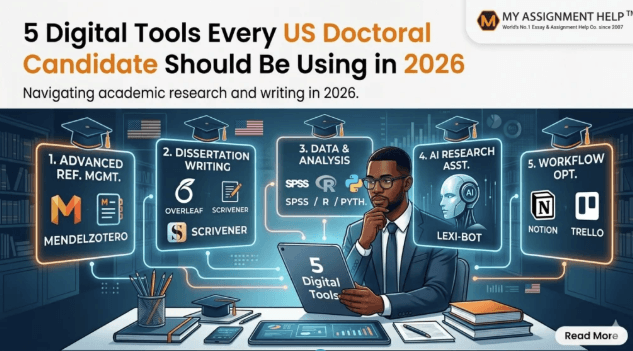
1. Scrivener 4.0: The Architectural Powerhouse
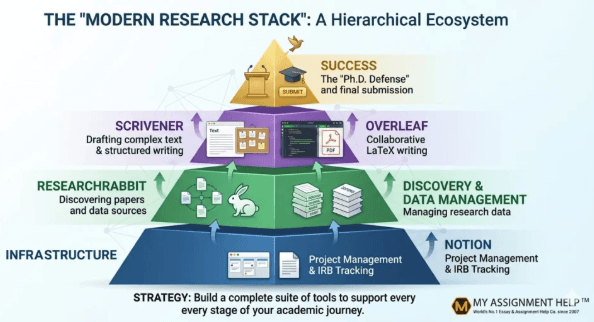
While traditional word processors are fine for essays, the 2026 version of Scrivener remains the gold standard for long-form academic projects. Unlike a linear document, Scrivener allows you to “chunk” your dissertation into manageable folders—Literature Review, Methodology, Data Analysis, and Findings.
For US candidates following strict APA 7th Edition or MLA 10 guidelines, Scrivener’s metadata tagging allows you to track which sources are cited in which sections. This prevents the “citation ghosting” that often leads to committee revisions.
2. ResearchRabbit: The “Spotify” of Academic Papers
Gone are the days of manually scouring JSTOR for hours. ResearchRabbit uses “citation-based discovery” to map out the genealogy of your research topic. By “following” a seminal paper in your field, the tool creates a visual map of every paper that has cited it, and every paper it cited.
In the US research landscape, where interdisciplinary work is highly valued, ResearchRabbit helps you find connections between seemingly unrelated fields, ensuring your literature review is exhaustive and modern.
3. Zotero with AI-Bridge Integration
Zotero remains the king of reference management, but in 2026, its power lies in its AI-Bridge plugins. These plugins don’t just store your PDFs; they summarize them using Natural Language Processing (NLP). You can ask your Zotero library, “Which of these 50 papers discusses the socioeconomic impact of telehealth in rural Texas?” and receive a cited summary in seconds.
4. Overleaf (LaTeX) for STEM and Data Analytics
For candidates in Engineering, Computer Science, or Finance, Overleaf has become the non-negotiable standard. In 2026, its real-time collaboration features allow your supervisor to leave “live” feedback on complex mathematical proofs. It handles the formatting of equations and bibliography styling automatically, so you don’t have to fight with margin errors at 3:00 AM.
5. Notion: The “Second Brain” for Project Management
A dissertation is not just a paper; it’s a multi-year project. US doctoral candidates are increasingly using Notion to build “Research Dashboards.” This includes:
- Grant Tracking: Monitoring application deadlines for NSF or NIH grants.
- IRB Approval Timelines: Tracking the status of Ethics Committee reviews.
- Daily Writing Habit Trackers: Ensuring a consistent word count.
Sometimes, the administrative load of these tools becomes a distraction itself. If you find yourself spending more time organizing your dashboard than actually writing, it might be time to delegate. Students often decide to do my homework for smaller, elective modules to free up the 20+ hours a week required for deep dissertation focus.
Key Takeaways for Success in 2026
- Centralize Your Data: Use one “Second Brain” tool (like Notion) to avoid app fatigue.
- Automate Citations early: Never leave your bibliography for the end of the semester.
- Visualize Your Connections: Use mapping tools to ensure your literature review isn’t just a list, but a conversation.
- Protect Your Mental Health: Utilize professional services when the workload threatens your progress.
FAQ: Navigating the Digital Dissertation
Q: Are these tools compliant with US university academic integrity policies?
A: Yes. Tools like Scrivener and Zotero are organizational. However, always check your specific institution’s policy regarding AI-summary tools to ensure you are meeting original thought requirements.
Q: How do I handle data privacy with cloud-based research tools?
A: Ensure the tools you use are SOC 2 compliant, especially if you are handling sensitive PII (Personally Identifiable Information) under HIPAA or FERPA regulations.
Q: Can I use these tools for both Qualitative and Quantitative research?
A: Absolutely. While Overleaf is great for Quantitative data, Scrivener and ResearchRabbit are exceptional for the narrative-heavy nature of Qualitative studies.
About the Author: Angelika
Senior Academic Consultant & Content Strategist
Angelika is a seasoned educator and senior strategist at MyAssignmentHelp. With over a decade of experience in the US and UK higher education sectors, she specializes in helping graduate students navigate the complexities of advanced research. Her work focuses on bridging the gap between digital innovation and academic excellence, ensuring that doctoral candidates have the tools and support needed to achieve their terminal degrees.
References & Data Sources
- National Center for Education Statistics (NCES) – Graduate Enrollment Trends 2025-2026.
- Council of Graduate Schools (CGS) – PhD Completion and Attrition Analysis.
- Journal of Academic Research Technology – “The Impact of NLP on Literature Synthesis” (2025).
- US Department of Education – Higher Education Digital Transformation Report.

 By
By